Info@birminghamphysiocare.co.uk
01213300272
+447743087832
650 Pershore Road, Birmingham, B29 7NX

- Clinic Overview
- TREATMENTS
- Manual Therapy
- Shockwave Therapy
- Low Level Laser Therapy (LLLT)
- Musculoskeletal MSK Ultrasound
- Ultrasound-Guided Injections
- Sports Massage
- Sports Injury Rehabilitation
- Post-Surgical & Injury Rehabilitation
- Chronic Pain Management
- Cupping Therapy
- Acupuncture & Dry Needling
- Workplace Assessments
- Exercise Rehabilitation
- MUSCULOSKELETAL
- NEUROLOGICAL
- ORTHOPAEDIC
- ELDERLY
- SPORTS
- HOME VISITS
- Pricing
- Contact Us
- Blogs & Case Studies

Professional Domiciliary Physiotherapy Services Delivered to Your Door Step
- Clinic Overview
- TREATMENTS
- Manual Therapy
- Shockwave Therapy
- Low Level Laser Therapy (LLLT)
- Musculoskeletal MSK Ultrasound
- Ultrasound-Guided Injections
- Sports Massage
- Sports Injury Rehabilitation
- Post-Surgical & Injury Rehabilitation
- Chronic Pain Management
- Cupping Therapy
- Acupuncture & Dry Needling
- Workplace Assessments
- Exercise Rehabilitation
- MUSCULOSKELETAL
- NEUROLOGICAL
- ORTHOPAEDIC
- ELDERLY
- SPORTS
- HOME VISITS
- Pricing
- Contact Us
- Blogs & Case Studies
- Clinic Overview
- TREATMENTS
- Manual Therapy
- Shockwave Therapy
- Low Level Laser Therapy (LLLT)
- Musculoskeletal MSK Ultrasound
- Ultrasound-Guided Injections
- Sports Massage
- Sports Injury Rehabilitation
- Post-Surgical & Injury Rehabilitation
- Chronic Pain Management
- Cupping Therapy
- Acupuncture & Dry Needling
- Workplace Assessments
- Exercise Rehabilitation
- MUSCULOSKELETAL
- NEUROLOGICAL
- ORTHOPAEDIC
- ELDERLY
- SPORTS
- HOME VISITS
- Pricing
- Contact Us
- Blogs & Case Studies
SPINAL CORD INJURY REHABILITATION · BIRMINGHAM PHYSIOCARE
A Spinal Cord Injury Redefines The Journey. Specialist Rehabilitation Shapes Where It Goes.
A spinal cord injury is one of the most life-altering events a person can experience. Whether the injury is complete or incomplete, traumatic or non-traumatic, the physical consequences reach far beyond the site of damage affecting movement, sensation, bladder and bowel function, cardiovascular regulation, skin integrity and respiratory capacity. The role of specialist physiotherapy is not to reverse what the injury has caused. It is to maximise every unit of function that remains and to prevent the secondary complications that consistently compound the primary disability when rehabilitation is absent or inadequate.
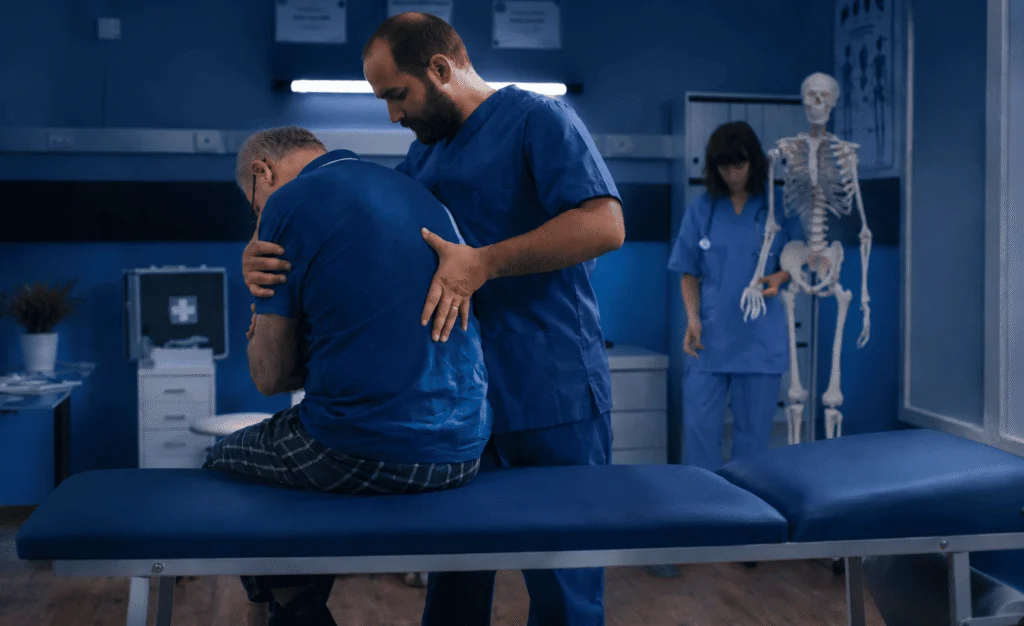
At Birmingham Physiocare Ltd on Pershore Road in Birmingham, our specialist physiotherapists deliver spinal cord injury rehabilitation aligned with the 2025 NICE guidelines for acquired spinal cord injury with a comprehensive assessment covering physical function, neurological status, mobility capacity and the functional demands of daily life before any programme is designed. For incomplete SCI where neurological recovery remains possible, the programme focuses on neuroplasticity-driven motor re-education and gait rehabilitation. For complete SCI, the focus shifts to maximising upper limb function, transfer ability, postural management and the prevention of secondary complications that determine long-term health and quality of life.
We treat at our clinic and through our domiciliary home visit service across Birmingham, Harborne, Edgbaston, Selly Oak, Moseley, Sutton Coldfield, Solihull and the wider West Midlands.
Spinal cord injury produces different functional consequences depending on the level of injury, whether the injury is complete or incomplete and the extent of any spontaneous neurological recovery. These are the presentations our specialist physiotherapists assess and treat directly.
Presentations we address
- Paraplegia and tetraplegia: Lower limb paralysis or four-limb involvement depending on the injury level. Rehabilitation focuses on maximising the function of unaffected muscle groups, transfer ability, wheelchair mobility and the prevention of complications.
- Incomplete SCI: Where neurological function below the injury level is partially preserved, targeted physiotherapy exploits available motor pathways to drive neuroplastic recovery through task-specific movement practice.
- Spasticity and tone management: Increased muscle tone is a common complication affecting transfer ability and comfort. Physiotherapy addresses this through stretching, positioning strategies and active movement.
- Balance and transfer rehabilitation: Safe and efficient transfers between surfaces are fundamental to independence. Assessment of transfer technique and postural control directly determines the level of daily independence achievable.
- Secondary complication prevention: Focused on pressure injury prevention, joint contracture prevention through stretching, and respiratory physiotherapy where trunk muscle function is affected.
- Gait rehabilitation: For incomplete SCI where walking recovery is a realistic goal, we apply body weight-supported training and progressive lower limb strengthening driven by neuroplasticity principles.
Get in touch with us
service timing ( Mon to Fri )
09 Am To 6 Pm
service timing ( Sat to Sun )
10:30 Am To 5 Pm
Our Services
Birmingham Physiocare In a nutshell
What Makes Birmingham Physiocare Different?
Book Your Physiotherapy Assessment!
How We Treat Spinal Cord Injury At Birmingham Physiocare
SCI TREATMENT
HUB BIRMINGHAM PHYSIOCARE
HUB BIRMINGHAM PHYSIOCARE
Incomplete SCI
Mobility Skills
Tone Mgmt
Upper Limb
Secondary Prev
Home Visits
Neuroplastic Recovery
Neurological rehabilitation for incomplete SCI
Task-specific, repetitive motor practice targeting the preserved and partially preserved motor pathways below the level of injury. The 2025 evidence base confirms that early, intensive and specifically targeted rehabilitation drives neuroplastic recovery in incomplete SCI.
These same principles underpinning stroke and TBI rehabilitation are applied to the specific anatomy and neurological status of the spinal cord injury.
Independence Focused
Transfer and functional mobility training
Systematic assessment and rehabilitation of sitting balance, surface transfers, floor transfers and the functional mobility skills that determine daily independence in both paraplegic and tetraplegic presentations.
Every transfer skill is practised to the level of safety and efficiency that real-world independence requires.
Tone & Contracture
Spasticity management
Stretching programmes, positioning strategies and active movement rehabilitation to manage tone, prevent contracture and maintain the range of movement needed for safe daily function.
Liaison with your medical team where medication or intrathecal baclofen is being considered alongside physiotherapy.
Strength Priorities
Upper limb strengthening and function
For paraplegic patients whose arms are their primary means of mobility and daily function, progressive upper limb strengthening and functional endurance training is a clinical priority.
For tetraplegic patients, maximising available upper limb and hand function directly determines the level of independence achievable across every aspect of daily life.
Complication Mgmt
Secondary complication prevention and management
Pressure area care education, respiratory physiotherapy for high-level injuries where respiratory muscle function is affected, cardiovascular conditioning through appropriate upper limb exercise and postural management to prevent the musculoskeletal complications of sustained immobility.
West Midlands Care
Home visit rehabilitation through our domiciliary service
For patients whose SCI makes clinic attendance impractical, specialist rehabilitation delivered at home across Birmingham and the West Midlands. The home environment is where independence matters most.
Rehabilitation directed at the actual living space, the real transfers and the specific daily tasks produces the most practically meaningful functional gains.
Commonly Asked Questions About Spinal Cord Injury
Essential FAQs
A complete spinal cord injury means no motor or sensory function is preserved below the level of injury. An incomplete injury means some function motor, sensory or both is preserved below the injury level. This distinction significantly shapes rehabilitation goals. In incomplete SCI, neuroplastic recovery of motor function below the injury level is a realistic target and rehabilitation focuses on driving that recovery through task-specific practice and progressive loading of available motor pathways. In complete SCI, recovery of function below the injury level is not a realistic goal and rehabilitation focuses on maximising function above the injury level, optimising transfer ability and independence, and preventing the secondary complications that determine long-term health.
As soon as medical stability allows. Early rehabilitation following SCI is essential to prevent joint contractures, maintain muscle strength in unaffected muscle groups, preserve bone density, maintain respiratory function and begin the neuroplastic recovery process in incomplete injuries where it is most active in the early post-injury period. The 2025 NICE guidelines on acquired spinal cord injury specifically recommend early identification of individual rehabilitation needs and early comprehensive assessment. If you have recently been discharged from hospital SCI care and your rehabilitation provision has reduced, contact us without delay.
Yes. Secondary complications develop progressively in SCI patients over time joint contractures, spasticity changes, shoulder injuries from transfers and wheeling, postural deterioration and cardiovascular deconditioning are all amenable to physiotherapy intervention regardless of the time since injury. Additionally, patients with incomplete SCI who did not receive sufficiently intensive rehabilitation in the early post-injury period sometimes achieve functional gains years later when the right approach is applied. Regular physiotherapy review throughout life in SCI is clinically justified both to address emerging complications and to reassess whether the current rehabilitation programme continues to reflect the patient's functional needs.
Yes. Our domiciliary physiotherapy service delivers specialist SCI rehabilitation directly at home across Birmingham and the wider West Midlands. For many patients with SCI, particularly those with high-level injuries or significant transfer difficulties, home visit rehabilitation is not simply more convenient it is more clinically effective. We assess the actual living environment, observe the real transfers the patient performs daily, identify the specific functional barriers in the home and direct every session at what matters most in the patient's daily life. Family members and carers are involved in every home visit with guidance on how to support the programme safely between sessions.
📍 Same-Day Appointments
Looking for Spinal Cord Injury Rehabilitation In Birmingham
Get expert assessment and diagnosis at our clinic on 650 Pershore Road, B29 7NX or in the comfort of your own home across Birmingham & the West Midlands.
✓ No GP referral required
✓ Direct specialist access
✓ Same-week appointments
Call us now — speak to a physio
0121 330 0272
or
Book Your Appointment
Instant confirmation • Free parking