Info@birminghamphysiocare.co.uk
01213300272
+447743087832
650 Pershore Road, Birmingham, B29 7NX

- Clinic Overview
- TREATMENTS
- Manual Therapy
- Shockwave Therapy
- Low Level Laser Therapy (LLLT)
- Musculoskeletal MSK Ultrasound
- Ultrasound-Guided Injections
- Sports Massage
- Sports Injury Rehabilitation
- Post-Surgical & Injury Rehabilitation
- Chronic Pain Management
- Cupping Therapy
- Acupuncture & Dry Needling
- Workplace Assessments
- Exercise Rehabilitation
- MUSCULOSKELETAL
- NEUROLOGICAL
- ORTHOPAEDIC
- ELDERLY
- SPORTS
- HOME VISITS
- Pricing
- Contact Us
- Blogs & Case Studies

Professional Domiciliary Physiotherapy Services Delivered to Your Door Step
- Clinic Overview
- TREATMENTS
- Manual Therapy
- Shockwave Therapy
- Low Level Laser Therapy (LLLT)
- Musculoskeletal MSK Ultrasound
- Ultrasound-Guided Injections
- Sports Massage
- Sports Injury Rehabilitation
- Post-Surgical & Injury Rehabilitation
- Chronic Pain Management
- Cupping Therapy
- Acupuncture & Dry Needling
- Workplace Assessments
- Exercise Rehabilitation
- MUSCULOSKELETAL
- NEUROLOGICAL
- ORTHOPAEDIC
- ELDERLY
- SPORTS
- HOME VISITS
- Pricing
- Contact Us
- Blogs & Case Studies
- Clinic Overview
- TREATMENTS
- Manual Therapy
- Shockwave Therapy
- Low Level Laser Therapy (LLLT)
- Musculoskeletal MSK Ultrasound
- Ultrasound-Guided Injections
- Sports Massage
- Sports Injury Rehabilitation
- Post-Surgical & Injury Rehabilitation
- Chronic Pain Management
- Cupping Therapy
- Acupuncture & Dry Needling
- Workplace Assessments
- Exercise Rehabilitation
- MUSCULOSKELETAL
- NEUROLOGICAL
- ORTHOPAEDIC
- ELDERLY
- SPORTS
- HOME VISITS
- Pricing
- Contact Us
- Blogs & Case Studies
PARKINSON'S DISEASE PHYSIOTHERAPY· BIRMINGHAM PHYSIOCARE
Parkinson's Changes How You Move. Specialist Physiotherapy Changes That Back
Parkinson's disease is progressive but the rate at which it affects daily function is not fixed. The difference between a patient whose walking, balance and independence decline steadily and one who maintains function for significantly longer is not the medication alone. It is whether specialist physiotherapy is consistently addressing the motor symptoms that medication cannot fully control the freezing of gait, the postural instability, the reduced stride length and the gradual loss of the automatic movement that makes daily life possible.
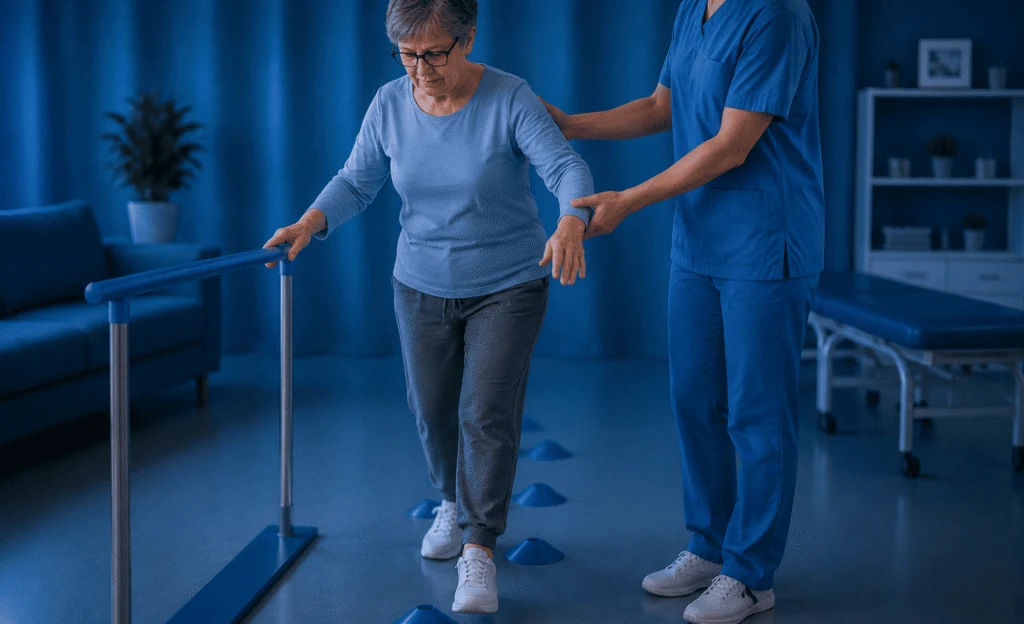
At Birmingham Physiocare Ltd on Pershore Road in Birmingham, our specialist neurological physiotherapists deliver Parkinson’s rehabilitation built on the current evidence base cueing strategies to address freezing of gait, progressive resistance training for bradykinesia and muscle weakness, balance and dual-task training for falls prevention, and LSVT BIG principles for amplitude of movement. We work with patients at every stage of Parkinson’s disease from early diagnosis through to more advanced presentations and adapt the programme as the condition changes.
We treat at our clinic and through our domiciliary home visit service across Birmingham, Harborne, Edgbaston, Selly Oak, Moseley, Sutton Coldfield, Solihull and the wider West Midlands.
Parkinson’s disease produces a distinctive constellation of motor symptoms that medication manages but does not eliminate and several that medication has limited impact on at all. These are the presentations our specialist physiotherapists assess and treat directly.
Motor symptoms we treat
- Freezing of gait sudden episodes where the feet stop moving despite the intention to walk, occurring most commonly at doorways and turns
- Reduced stride length and shuffling gait producing increased falls risk and exhaustion on walking
- Bradykinesia slowness of movement affecting the speed and amplitude of everyday actions
- Postural instability and balance impairment reduced ability to correct balance when displaced
- Rigidity muscle stiffness in the limbs and trunk limiting range of movement and contributing to postural change
- Stooped posture and forward flexed trunk position affecting balance, breathing and swallowing
- Reduced arm swing on the affected side altering gait symmetry and balance
- Difficulty with transfers rising from chairs, getting in and out of bed, moving from sitting to standing
Who we work with
- Every Stage of Parkinson’s: Patients at any stage from newly diagnosed seeking to maintain function through to advanced presentations requiring specialist management.
- Persistent Motor Symptoms: Patients whose medication is well-controlled but whose motor symptoms remain significantly limiting between doses.
- Falls Prevention: Patients who have fallen or who are at increasing falls risk requiring dedicated balance and gait rehabilitation.
- Home-Based Care: Patients receiving rehabilitation at home through our domiciliary service for whom clinic attendance is not practical.
Get in touch with us
service timing ( Mon to Fri )
09 Am To 6 Pm
service timing ( Sat to Sun )
10:30 Am To 5 Pm
Our Services
Birmingham Physiocare In a nutshell
What Makes Birmingham Physiocare Different?
Book Your Physiotherapy Assessment!
How We Treat Parkinson's Disease At Birmingham Physiocare
PARKINSON'S
TREATMENT BIRMINGHAM PHYSIOCARE
TREATMENT BIRMINGHAM PHYSIOCARE
Gait & Cueing
Resistance Training
Balance & Falls
LSVT BIG / Amp
Home Care
Posture & Joint Mobility
Neurological Bypass
Gait Rehabilitation and Cueing Strategies
Targeted walking re-education using auditory, visual and attentional cueing to bypass the basal ganglia dysfunction responsible for freezing of gait and reduced stride length.
Rhythmic auditory cueing ; using a consistent beat to regulate step timing ; directly increases gait velocity, step length and reduces freezing episodes. Strategies are practised functionally in the environments where freezing most commonly occurs.
Evidence-Based 2022
Progressive Resistance Training
Meta-analysis evidence confirms that progressive resistance training improves freezing of gait, increases muscle strength and improves quality of life in Parkinson's.
Your physiotherapist designs a programme that progressively challenges the affected muscle groups within your current capacity ; building strength that supports safer movement and reduces physical deconditioning.
Systematic Prevention
Balance and Falls Prevention
A detailed assessment of your balance deficits and falls history is followed by a programme of static and dynamic balance training, dual-task practice and postural response training.
As falls are a serious physical consequence of Parkinson's, this systematic approach directly reduces falls frequency and the fear of falling that leads to activity restriction.
High-Intensity Training
Amplitude and LSVT BIG Principles
Exercises focused on larger, more exaggerated movement amplitude to counter the characteristic movement reduction of Parkinson's.
High-amplitude, high-intensity repetitive movement has the strongest evidence base for motor function improvement and forms the foundation of each session's exercise component.
Specialist Home Visits
Domiciliary Rehabilitation
For patients whose Parkinson's makes travel difficult, we deliver the same specialist rehabilitation programme at your home.
By observing how you move through your actual living environment, we identify specific freezing triggers, fall hazards and functional tasks that require direct rehabilitation input.
Flexibility & Alignment
Posture & Joint Mobility
Targeted axial extension and spinal rotation exercises designed to counteract flexed postures, rigidity, and reduced trunk range of motion.
Targeting shortened muscle groups and stiff spinal segments helps maintain upright positioning, improves thoracic expansion for breathing, and enhances rotational movement required for everyday tasks.
Commonly Asked Questions About Parkinson's
Essential FAQs
Physiotherapy does not alter the underlying neurological progression of Parkinson's disease. What it does consistently and with strong evidence is slow the rate at which the motor symptoms of Parkinson's affect daily function. Progressive resistance training, gait rehabilitation and balance training maintain the physical capacity, movement quality and falls resilience that deteriorate when activity decreases. Patients who receive regular specialist physiotherapy consistently maintain functional independence for longer than those who do not and the difference compounds over time as the condition advances.
Freezing of gait in Parkinson's is caused by basal ganglia dysfunction disrupting the automatic motor programmes responsible for initiating and continuing movement. Cueing strategies auditory rhythm, visual floor markers and attentional focus techniques provide an external trigger that bypasses the disrupted internal initiation pathway, allowing movement to begin. Research confirms physiotherapy focusing on cueing strategies produces significant short-term improvements in freezing severity, gait velocity and step length. Your physiotherapist teaches you specific strategies for the situations where freezing most commonly occurs doorways, turns, crowds and practises them with you until they become automatic.
Yes our domiciliary physiotherapy service delivers specialist Parkinson's rehabilitation directly at home across Birmingham and the wider West Midlands. The home visit model has specific clinical advantages for Parkinson's patients we see the actual environment where falls occur, the specific doorways and turns that trigger freezing, the chair heights that make transfers difficult and the floor surfaces that challenge balance. Rehabilitation directed at the real environment rather than a clinic setting is often more practically useful and produces faster functional gains in daily life.
As early as possible ideally at or shortly after diagnosis, before significant functional decline has occurred. Early physiotherapy establishes baseline function, educates the patient and family about what to expect as the condition progresses, introduces exercise habits that delay functional deterioration and identifies the specific areas of motor function most at risk. Patients who begin specialist physiotherapy early in their diagnosis consistently maintain better function at later stages than those who wait until symptoms become significantly disabling. There is no advantage to waiting and substantial evidence for starting early.
📍 Same-Day Appointments
Looking for Parkinson's Rehabilitation? In Birmingham
Get expert assessment and diagnosis at our clinic on 650 Pershore Road, B29 7NX or in the comfort of your own home across Birmingham & the West Midlands.
✓ No GP referral required
✓ Direct specialist access
✓ Same-week appointments
Call us now — speak to a physio
0121 330 0272
or
Book Your Appointment
Instant confirmation • Free parking