Info@birminghamphysiocare.co.uk
01213300272
+447743087832
650 Pershore Road, Birmingham, B29 7NX

- Clinic Overview
- TREATMENTS
- Manual Therapy
- Shockwave Therapy
- Low Level Laser Therapy (LLLT)
- Musculoskeletal MSK Ultrasound
- Ultrasound-Guided Injections
- Sports Massage
- Sports Injury Rehabilitation
- Post-Surgical & Injury Rehabilitation
- Chronic Pain Management
- Cupping Therapy
- Acupuncture & Dry Needling
- Workplace Assessments
- Exercise Rehabilitation
- MUSCULOSKELETAL
- NEUROLOGICAL
- ORTHOPAEDIC
- ELDERLY
- SPORTS
- HOME VISITS
- Pricing
- Contact Us
- Blogs & Case Studies

Professional Domiciliary Physiotherapy Services Delivered to Your Door Step
- Clinic Overview
- TREATMENTS
- Manual Therapy
- Shockwave Therapy
- Low Level Laser Therapy (LLLT)
- Musculoskeletal MSK Ultrasound
- Ultrasound-Guided Injections
- Sports Massage
- Sports Injury Rehabilitation
- Post-Surgical & Injury Rehabilitation
- Chronic Pain Management
- Cupping Therapy
- Acupuncture & Dry Needling
- Workplace Assessments
- Exercise Rehabilitation
- MUSCULOSKELETAL
- NEUROLOGICAL
- ORTHOPAEDIC
- ELDERLY
- SPORTS
- HOME VISITS
- Pricing
- Contact Us
- Blogs & Case Studies
- Clinic Overview
- TREATMENTS
- Manual Therapy
- Shockwave Therapy
- Low Level Laser Therapy (LLLT)
- Musculoskeletal MSK Ultrasound
- Ultrasound-Guided Injections
- Sports Massage
- Sports Injury Rehabilitation
- Post-Surgical & Injury Rehabilitation
- Chronic Pain Management
- Cupping Therapy
- Acupuncture & Dry Needling
- Workplace Assessments
- Exercise Rehabilitation
- MUSCULOSKELETAL
- NEUROLOGICAL
- ORTHOPAEDIC
- ELDERLY
- SPORTS
- HOME VISITS
- Pricing
- Contact Us
- Blogs & Case Studies
Osteoarthritis PHYSIOTHERAPY · BIRMINGHAM PHYSIOCARE
Arthritis Is Not The End Of The Story. It Is The Beginning Of The Right Treatment.
Osteoarthritis is the most over-dismissed condition in musculoskeletal medicine. Patients are shown an X-ray, told their cartilage is worn and advised to manage with medication and activity modification. What they are rarely told is that the degree of joint degeneration visible on imaging correlates poorly with the severity of symptoms and that physiotherapy, exercise therapy and targeted injection management consistently produce meaningful improvements in pain and function even in joints with significant radiological change.
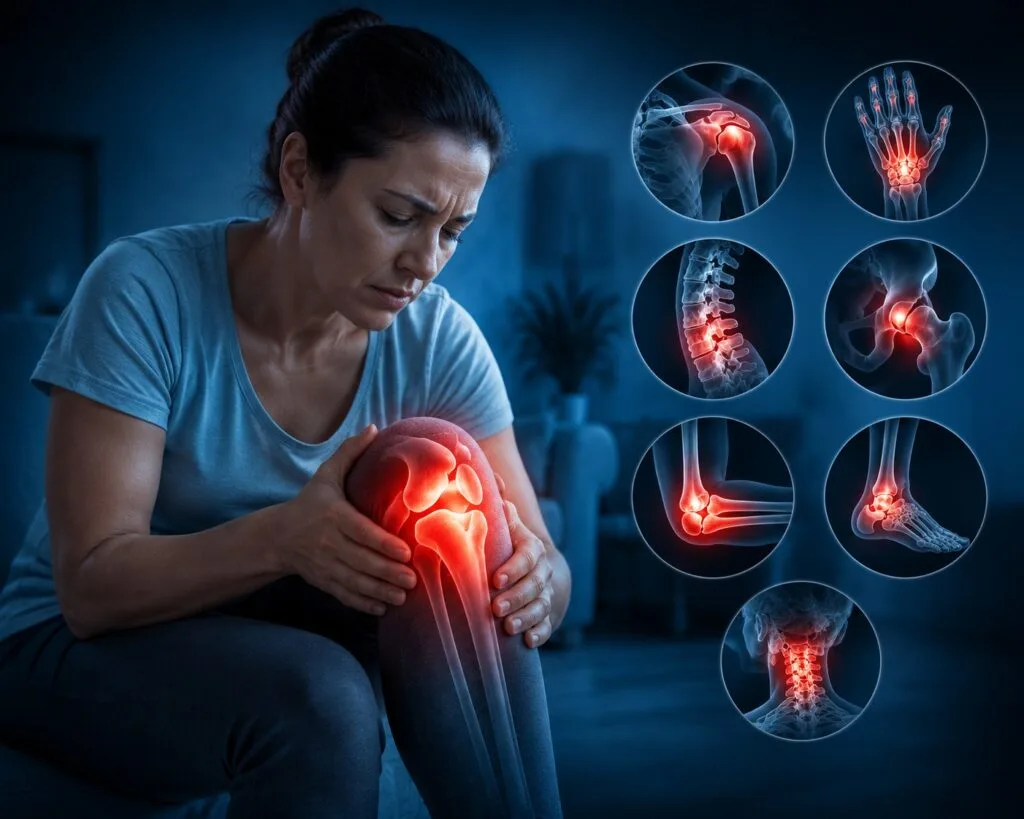
At Birmingham Physiocare Ltd on Pershore Road in Birmingham, osteoarthritis is treated as a condition with a defined management pathway not an inevitable consequence of age that patients simply accept. We combine manual therapy to restore joint mechanics, exercise rehabilitation to build the muscular support that protects the affected joint, and Ultrasound-Guided Injection where joint inflammation is limiting rehabilitation progress. Where imaging is needed before treatment begins, our Musculoskeletal Ultrasound confirms the extent of joint pathology and rules out concurrent conditions that standard OA management will not address.
We treat patients at our Pershore Road clinic and through our domiciliary home visit service across Birmingham, Harborne, Edgbaston, Selly Oak, Moseley, Sutton Coldfield, Solihull and the wider West Midlands.
Osteoarthritis presents differently depending on the joint affected but the underlying pattern of symptoms is consistent across all presentations. The location of pain, the stiffness pattern and what activities provoke or ease symptoms all guide the assessment and inform which treatment approach is most appropriate.
Common symptoms
- Pain and stiffness that is worst after rest and on first movement in the morning
- Aching that builds during prolonged activity and eases with rest
- A grinding, creaking or crunching sensation in the affected joint
- Swelling around the joint with or without warmth
- Progressive restriction of range of movement
- Weakness and instability in the muscles surrounding the joint
- Pain that limits specific daily activities walking, stairs, dressing, gripping
Joints we treat
- Knee osteoarthritis: Tibiofemoral and patellofemoral compartment degeneration. Hyaluronic acid injection under ultrasound guidance restores joint lubrication when rehabilitation alone is insufficient.
- Hip osteoarthritis: Groin pain and stiffness on rising from seated. Intra-articular injection under ultrasound guidance provides targeted treatment directly inside the hip joint for maximum accuracy.
- Spinal facet joint arthritis: Degenerative change in the cervical, thoracic or lumbar joints producing stiffness and pain responding directly to manual therapy at the specific spinal level.
- Shoulder osteoarthritis: Joint degeneration producing pain on overhead movement and across-body reaching. MSK Ultrasound confirms involvement and guides precise injection therapy.
- Hand and thumb osteoarthritis: Carpometacarpal thumb joint OA producing pain on pinching and gripping. Ultrasound-guided injection is particularly effective for inflammatory flares in these small joints.
- Ankle osteoarthritis: Often post-traumatic following fractures or chronic instability. Manual therapy, progressive loading and guided injection into the tibiotalar joint manage symptoms effectively.
Get in touch with us
service timing ( Mon to Fri )
09 Am To 6 Pm
service timing ( Sat to Sun )
10:30 Am To 5 Pm
Our Services
Birmingham Physiocare In a nutshell
What Makes Birmingham Physiocare Different?
Book Your Physiotherapy Assessment!
How We Treat Osteoarthritis At Birmingham Physiocare
ARTHRITIS
TREATMENT HUB
Exercise Rehab
Manual Therapy
Guided Injection
MSK Ultrasound
Acupuncture
Primary Intervention
Exercise Rehabilitation
The single most evidence-supported intervention for osteoarthritis across all joints. Progressive strengthening reduces mechanical load on damaged cartilage and improves stability.
This produces lasting improvements in pain and daily function that passive treatments alone cannot achieve, empowering long-term joint health.
Mechanical Relief
Manual Therapy
Joint mobilisation targeted at the affected area reduces stiffness, restores range of movement, and reduces the pain limiting effective rehabilitation loading.
It is particularly effective for spinal facet joint arthritis, hip, and knee OA where restricted mechanics are compounding the symptoms of cartilage degeneration.
Precision Placement
Ultrasound-Guided Injection
Corticosteroid for acute inflammatory flare-ups and hyaluronic acid viscosupplementation for joint lubrication, both placed precisely inside the joint space.
The accuracy of ultrasound is critical for the hip, shoulder, and thumb CMC joint where landmark-guided injections often fail to reach the intra-articular target.
Diagnostic Clarity
Musculoskeletal Ultrasound
Real-time imaging confirming the degree of joint pathology and identifying concurrent tendon or bursal involvement.
This allows us to guide injection therapy to the precise target structure at the same appointment as your clinical assessment, ensuring no time is wasted.
Neuromuscular Modulation
Acupuncture
Periarticular needling for knee, hip, and shoulder OA reduces pain and muscle inhibition, improving the quality of muscle activation needed for rehabilitation.
By lowering pain levels that prevent meaningful joint loading, acupuncture serves as a vital bridge to successful exercise therapy.
Commonly Asked Questions About Back Osteoarthritis
Essential FAQs
No and this is one of the most important points to understand about osteoarthritis. Radiological severity correlates poorly with symptom severity. Many patients with advanced imaging findings achieve full resolution of their functional limitations through physiotherapy. Much of the pain and restriction in osteoarthritis is driven by muscle weakness, joint stiffness, movement pattern dysfunction and inflammation all of which physiotherapy directly addresses regardless of what the X-ray shows. Your symptoms and your function determine your treatment plan and your recovery potential, not your imaging report.
Corticosteroid works as a potent anti-inflammatory reducing pain and swelling rapidly with maximum benefit within one to two weeks. It is most appropriate when inflammatory flare-up is the primary problem and when the goal is creating a window of pain reduction sufficient for rehabilitation to begin. Hyaluronic acid restores the viscosity and lubrication of the synovial fluid that arthritic cartilage can no longer maintain it works gradually but its effects last considerably longer, with peak benefit at eight weeks and residual effect up to six months. Your physiotherapist will recommend the appropriate type based on your specific joint, the stage of your OA and what previous treatment has produced.
For many patients, yes. Research consistently shows that patients who receive structured physiotherapy for hip and knee osteoarthritis before considering surgery experience better outcomes including a significant proportion who find surgical intervention is no longer necessary. A knee or hip replacement is a major procedure with its own demands and recovery. Physiotherapy is always worth a properly supervised, structured trial first. For patients who do proceed to surgery, a prehabilitation programme in the weeks before the operation significantly improves surgical outcomes and recovery speed.
Yes. Many patients present with osteoarthritis in multiple joints simultaneously knee and hip, hand and shoulder, or spinal and peripheral joint involvement together. Birmingham Physiocare manages multi-joint presentations by prioritising the joint causing the greatest functional limitation and building a coordinated programme that addresses each affected joint appropriately. Where multiple joints require injection therapy, sessions are planned to address each in sequence without overloading your capacity to engage with rehabilitation across multiple areas at the same time.
📍 Same-Day Appointments
Still Living With Osteoarthritis?
Get expert assessment and diagnosis at our clinic on 650 Pershore Road, B29 7NX or in the comfort of your own home across Birmingham & the West Midlands.
✓ No GP referral required
✓ Direct specialist access
✓ Same-week appointments
Call us now — speak to a physio
0121 330 0272
or
Book Your Appointment
Instant confirmation • Free parking