Info@birminghamphysiocare.co.uk
01213300272
+447743087832
650 Pershore Road, Birmingham, B29 7NX

- Clinic Overview
- TREATMENTS
- Manual Therapy
- Shockwave Therapy
- Low Level Laser Therapy (LLLT)
- Musculoskeletal MSK Ultrasound
- Ultrasound-Guided Injections
- Sports Massage
- Sports Injury Rehabilitation
- Post-Surgical & Injury Rehabilitation
- Chronic Pain Management
- Cupping Therapy
- Acupuncture & Dry Needling
- Workplace Assessments
- Exercise Rehabilitation
- MUSCULOSKELETAL
- NEUROLOGICAL
- ORTHOPAEDIC
- ELDERLY
- SPORTS
- HOME VISITS
- Pricing
- Contact Us
- Blogs & Case Studies

Professional Domiciliary Physiotherapy Services Delivered to Your Door Step
- Clinic Overview
- TREATMENTS
- Manual Therapy
- Shockwave Therapy
- Low Level Laser Therapy (LLLT)
- Musculoskeletal MSK Ultrasound
- Ultrasound-Guided Injections
- Sports Massage
- Sports Injury Rehabilitation
- Post-Surgical & Injury Rehabilitation
- Chronic Pain Management
- Cupping Therapy
- Acupuncture & Dry Needling
- Workplace Assessments
- Exercise Rehabilitation
- MUSCULOSKELETAL
- NEUROLOGICAL
- ORTHOPAEDIC
- ELDERLY
- SPORTS
- HOME VISITS
- Pricing
- Contact Us
- Blogs & Case Studies
- Clinic Overview
- TREATMENTS
- Manual Therapy
- Shockwave Therapy
- Low Level Laser Therapy (LLLT)
- Musculoskeletal MSK Ultrasound
- Ultrasound-Guided Injections
- Sports Massage
- Sports Injury Rehabilitation
- Post-Surgical & Injury Rehabilitation
- Chronic Pain Management
- Cupping Therapy
- Acupuncture & Dry Needling
- Workplace Assessments
- Exercise Rehabilitation
- MUSCULOSKELETAL
- NEUROLOGICAL
- ORTHOPAEDIC
- ELDERLY
- SPORTS
- HOME VISITS
- Pricing
- Contact Us
- Blogs & Case Studies
SHOCKWAVE THERAPY· BIRMINGHAM PHYSIOCARE
Your Tendon Has Stopped Healing Itself. Shockwave Makes It Start Again.
Chronic tendon pain does not persist because you have not rested enough or stretched enough. It persists because the tendon has undergone a biological shift called tendinopathy or frayed, a state where the normal repair cycle has broken down, blood supply to the damaged tissue has reduced and the cellular activity required for healing has effectively ceased. In this degenerative state, the tendon is not inflamed. It is essentially dormant. Rest does not restart a dormant repair process. Loading alone is insufficient when the tissue has lost the capacity to respond to it appropriately. Something has to restart the mechanism itself.
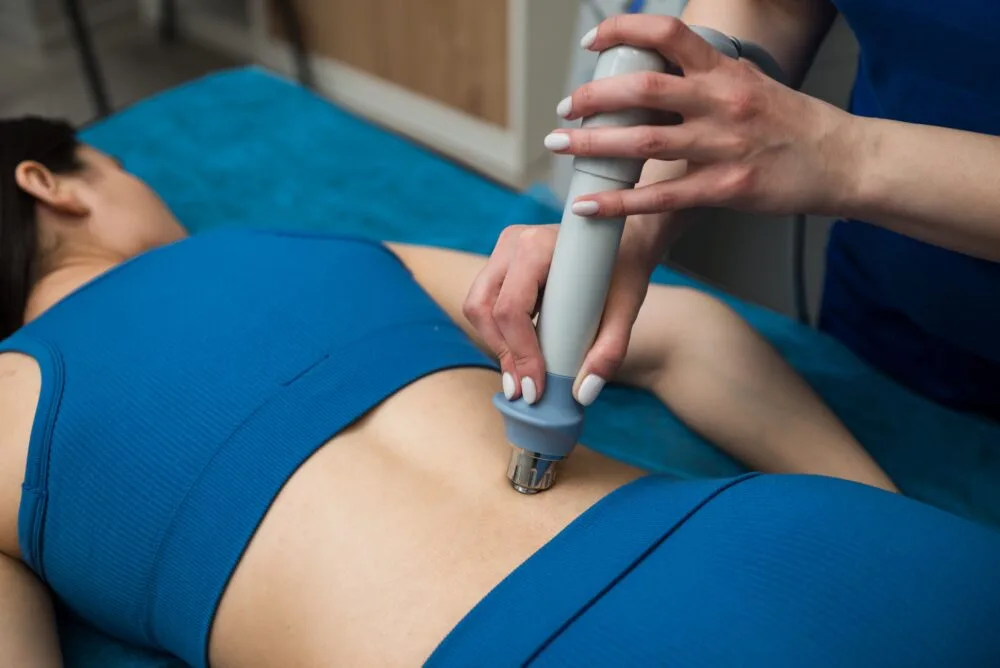
Shockwave Therapy, SWT, delivers high energy acoustic waves through the skin to the affected tendon, generating a transient pressure disturbance at the tissue level. This mechanical stimulus triggers neovascularisation, the formation of new blood vessels supplying the previously under perfused tissue, alongside stimulation of tenocyte activity and collagen synthesis, the cellular machinery the tendon needs to repair. A June 2025 systematic review and meta-analysis published in Foot and Ankle Surgery, comparing ESWT against multiple other modalities for plantar fasciitis, confirmed shockwave therapy produces comparable or superior results to other established treatments, with high-quality evidence confirming a large effect on pain and function for plantar fasciitis specifically. For patellar and Achilles tendinopathy the evidence grades as low to moderate, a distinction we communicate honestly to every patient rather than overstating what the research actually says.
At Birmingham Physiocare Ltd on Pershore Road in Birmingham, shockwave therapy is delivered following diagnostic confirmation of the target structure through MSK Ultrasound, ensuring every session of treatment targets the precise zone of tissue pathology identified on imaging rather than the anatomical region of pain alone.
Shockwave therapy is not appropriate for every tendon condition, and our physiotherapist will be precise about where the evidence supports its use. These are the conditions where Birmingham Physiocare consistently achieves strong clinical results and where the research evidence specifically supports the treatment.
Where Shockwave Therapy Delivers Results
- Plantar Fasciitis: The strongest evidence base of any shockwave application. High-quality evidence from multiple systematic reviews confirms a large effect on pain and function, with the 2025 meta-analysis in Foot and Ankle Surgery confirming ESWT produces results comparable or superior to competing modalities. Three sessions at weekly intervals, each delivering 1800 impulses at appropriate energy parameters, is the most widely used evidence-based protocol, though your physiotherapist will adjust this based on MSK Ultrasound findings confirming fascial thickness and pathology extent.
- Calcific Tendinopathy Of The Rotator Cuff: High-quality evidence confirms ESWT produces a large effect on pain and function for calcific shoulder tendinopathy, with FDA approval specifically covering this indication. Shockwave disrupts calcific deposits mechanically while simultaneously stimulating the surrounding tendon tissue, an effect impossible to achieve through injection or exercise alone.
- Midportion Achilles Tendinopathy: Consistent evidence from four RCTs confirms ESWT is effective for midportion Achilles tendinopathy, reducing pain and improving function. The best available evidence suggests combination with eccentric exercise produces superior outcomes to shockwave alone, which is why exercise rehabilitation is always integrated alongside treatment at Birmingham Physiocare.
- Lateral Epicondylitis: FDA approval for lateral epicondylitis, with systematic review evidence confirming ESWT outperformed physiotherapy alone for pain, disability scores and grip strength in a direct comparative trial.
- Patellar Tendinopathy: Low to moderate evidence, communicated honestly, supports ESWT as a useful intervention where conservative loading programmes have not achieved adequate resolution, with the evidence base acknowledging the absence of a practical clinical guideline for this specific condition.
- Gluteal Tendinopathy: Chronic greater trochanteric pain driven by gluteal tendinopathy, frequently the genuine diagnosis behind lateral hip pain misattributed to arthritis without MSK Ultrasound confirmation, responds to the same neovascularisation and tissue regeneration mechanism that underpins shockwave in other chronic tendinopathies.
Get in touch with us
service timing ( Mon to Fri )
09 Am To 6 Pm
service timing ( Sat to Sun )
10:30 Am To 5 Pm
Our Treatments
Birmingham Physiocare In a nutshell
What Makes Birmingham Physiocare Different?
Book Your Physiotherapy Assessment !
Imaging Confirms The Target Before Session One
Every shockwave patient at Birmingham Physiocare receives MSK Ultrasound confirmation of the pathology before treatment begins, ensuring acoustic energy targets the precise zone of tissue degeneration rather than the anatomical region the pain is felt in, two things that are not always the same.
When Standard Treatment Has Not Been Enough
Shockwave is specifically designed for the patient who has already completed physiotherapy, NSAIDS and rested adequately without lasting resolution.
Home Visits Across Birmingham
Our domiciliary service delivers the same graded, technique-specific manual therapy directly to your home across Birmingham and the West Midlands for patients where clinic attendance is not possible.
HCPC & MCSP Registered
Our domiciliary service extends shockwave therapy to patients across Birmingham and the West Midlands who cannot travel to our Pershore Road clinic. Contact us to confirm clinical suitability for your specific presentation.
THREE TO SIX SESSIONS. ONE WEEK APART. TISSUE RESPONSE
From First Appointment To Full Recovery
RECOVERY RX
BIRMINGHAM PHYSIOCARE
Session 1: Target Mapping
Sessions 2-4: Acoustic Titration
Sessions 5-6: Load Consolidation
Diagnostics & Target
Session One: Confirm The Target And Establish The Baseline
Before any shockwave is delivered, your physiotherapist conducts a clinical assessment and MSK Ultrasound scan to confirm the diagnosis, identify the precise zone of tendon pathology and establish a baseline for measuring your response across the treatment course.
Energy parameters, typically between 0.08 and 0.40 mJ per mm² depending on your specific condition and tissue tolerance, pulse count of 1800 impulses per session, and frequency settings are determined individually based on what the imaging confirms rather than a default protocol.
Contraindications including local infection, blood-thinning medication, active malignancy and pregnancy are reviewed and confirmed absent before the first pulse is delivered.
Response-Driven Delivery
Sessions Two Through Four: Deliver Treatment, Review Response Each Time
Coupling gel is applied to the skin over the treatment zone identified on imaging. The shockwave handpiece is positioned at the target, and the acoustic pulses are delivered at the confirmed parameters.
Most patients experience a deep, aching pressure sensation during treatment, the intensity of which typically reduces across the course as tissue response develops.
Your physiotherapist reassesses your pain levels, functional markers and tissue response at every appointment, adjusting parameters within the same session if your response indicates either insufficient or excessive tissue stimulus. This is not a fixed protocol delivered identically across every session regardless of how you are responding.
Mechanical Alignment
Session Five And Six: Consolidate With Graduated Loading
Current evidence, including systematic review data on Achilles tendinopathy specifically, confirms that shockwave combined with eccentric loading produces superior outcomes to shockwave alone.
From session three onwards, your physiotherapist introduces a graduated tendon loading programme running alongside the shockwave treatment, combining the mechanical regeneration the acoustic waves have initiated with the progressive loading stimulus that consolidates tissue repair into durable function.
Most patients complete between three and six sessions. Plantar fasciitis typically responds within three to four sessions. Calcific shoulder tendinopathy and chronic Achilles tendinopathy frequently benefit from a full six-session course. Your response determines the number, not a pre-set course length decided at session one.
TESTIMONIALS
What Our Patients Say About Their Journey

Fourteen months of plantar fasciitis. Orthotics, two courses of physiotherapy, a steroid injection nothing gave me lasting relief. Birmingham Physiocare scanned the foot, confirmed the diagnosis properly and recommended shockwave. After the third session the morning pain that had defined my days for over a year started to ease. By session five it was gone.
The shoulder pain was affecting everything sleep, work, lifting anything above my head. The ultrasound showed a significant calcific deposit the previous X-rays had not fully characterised. Four sessions in and the improvement was dramatic. Six sessions and I had full pain-free movement for the first time in two years.
Eighteen months of tennis elbow that had not responded to anything rest, a brace, an injection. Birmingham Physiocare explained clearly why chronic tendinopathy behaves the way it does and why shockwave addresses the actual problem. The improvement started after session two and built consistently. I am back training without restriction.
Frequently Asked Questions About Shockwave Therapy at Birmingham
Essential FAQs
The most widely used evidence-based protocol across plantar fasciitis trials is three sessions delivered weekly, each at 1800 impulses. For calcific shoulder tendinopathy and chronic Achilles tendinopathy, a full six-session course is typically required. The interval between sessions is one week, allowing adequate tissue response time while maintaining consistent treatment momentum. Your physiotherapist reviews your response at every session, meaning the number of sessions is confirmed by how your tissue is actually responding rather than a fixed course decided at the outset.
Most patients experience a deep aching or pressure sensation during treatment rather than sharp pain. The sensation typically reduces across the course as tissue response develops. Parameters are adjusted during your session based on your response. Some patients experience temporary soreness in the treated area for 24 to 48 hours following each session, a normal biological indicator that the tissue has received the mechanical stimulus and the cellular repair process has been activated.
The evidence varies honestly by condition. High-quality evidence from multiple systematic reviews confirms a large effect for plantar fasciitis, with the June 2025 meta-analysis in Foot and Ankle Surgery specifically confirming ESWT produces comparable or superior results to competing modalities. High-quality evidence also supports a large effect for calcific rotator cuff tendinopathy, with FDA approval for both these indications. For patellar tendinopathy and Achilles tendinopathy the evidence grades as low to moderate, reflecting the absence of strong consensus, though consistent RCT data supports its use for midportion Achilles tendinopathy specifically.
Injections, particularly corticosteroid, address inflammatory mediators rather than the degenerative tissue change that characterises chronic tendinopathy. When a tendon has moved beyond the inflammatory phase into genuine degeneration, corticosteroid has limited tissue-level effect on the underlying pathology, explaining the temporary benefit followed by return of symptoms that most patients with chronic tendinopathy describe. Shockwave targets the degeneration directly, stimulating neovascularisation and tenocyte activity in tissue that corticosteroid cannot reach. Whether shockwave is appropriate for your specific presentation is confirmed at your assessment before any treatment is agreed.
Yes. Shockwave is contraindicated in the presence of local infection at the treatment site, blood-thinning medication, active malignancy, open growth plates in skeletally immature patients, pregnancy and treatment directly over nerve or major blood vessel structures. A thorough medical history is reviewed before session one and no treatment is delivered where contraindications are identified.
Yes, and this is the most clinically effective approach the evidence supports. Current systematic review data on Achilles tendinopathy specifically confirms shockwave combined with eccentric loading produces superior outcomes to shockwave alone. At Birmingham Physiocare, exercise rehabilitation and manual therapy are integrated alongside the shockwave course from session three onwards, and where MSK Ultrasound identifies concurrent bursal involvement, ultrasound-guided injection can be sequenced alongside the shockwave programme as part of the same coordinated plan.
SAME-DAY DIAGNOSTIC IMAGING
Looking for Shockwave Therapy In Birmingham?
Evidence-based ESWT with MSK Ultrasound diagnosis before every course at 650 Pershore Road, Selly Oak, Birmingham B29 7NX. Speak to our specialist team today.
✓ Evidence-Based ESWT
✓ On-Site MSK Ultrasound
✓ Direct Specialist Access
Call us now — speak to a physio
0121 330 0272
or
Book Your Appointment
Instant confirmation • Free parking