Info@birminghamphysiocare.co.uk
01213300272
+447743087832
650 Pershore Road, Birmingham, B29 7NX

- Clinic Overview
- TREATMENTS
- Manual Therapy
- Shockwave Therapy
- Low Level Laser Therapy (LLLT)
- Musculoskeletal MSK Ultrasound
- Ultrasound-Guided Injections
- Sports Massage
- Sports Injury Rehabilitation
- Post-Surgical & Injury Rehabilitation
- Chronic Pain Management
- Cupping Therapy
- Acupuncture & Dry Needling
- Workplace Assessments
- Exercise Rehabilitation
- MUSCULOSKELETAL
- NEUROLOGICAL
- ORTHOPAEDIC
- ELDERLY
- SPORTS
- HOME VISITS
- Pricing
- Contact Us
- Blogs & Case Studies

Professional Domiciliary Physiotherapy Services Delivered to Your Door Step
- Clinic Overview
- TREATMENTS
- Manual Therapy
- Shockwave Therapy
- Low Level Laser Therapy (LLLT)
- Musculoskeletal MSK Ultrasound
- Ultrasound-Guided Injections
- Sports Massage
- Sports Injury Rehabilitation
- Post-Surgical & Injury Rehabilitation
- Chronic Pain Management
- Cupping Therapy
- Acupuncture & Dry Needling
- Workplace Assessments
- Exercise Rehabilitation
- MUSCULOSKELETAL
- NEUROLOGICAL
- ORTHOPAEDIC
- ELDERLY
- SPORTS
- HOME VISITS
- Pricing
- Contact Us
- Blogs & Case Studies
- Clinic Overview
- TREATMENTS
- Manual Therapy
- Shockwave Therapy
- Low Level Laser Therapy (LLLT)
- Musculoskeletal MSK Ultrasound
- Ultrasound-Guided Injections
- Sports Massage
- Sports Injury Rehabilitation
- Post-Surgical & Injury Rehabilitation
- Chronic Pain Management
- Cupping Therapy
- Acupuncture & Dry Needling
- Workplace Assessments
- Exercise Rehabilitation
- MUSCULOSKELETAL
- NEUROLOGICAL
- ORTHOPAEDIC
- ELDERLY
- SPORTS
- HOME VISITS
- Pricing
- Contact Us
- Blogs & Case Studies
MUSCULOSKELETAL ULTRASOUND SCANNING · BIRMINGHAM PHYSIOCARE
Stop Guessing Where The Pain Comes From. See It.
Most musculoskeletal pain has a precise origin a specific tendon degenerating, a bursa inflamed, a ligament partially torn, a nerve compressed at a defined anatomical point. Clinical examination identifies likely causes. Musculoskeletal ultrasound imaging confirms them in real time, at the same appointment, without a referral to a hospital imaging department and without a waiting list measured in weeks.
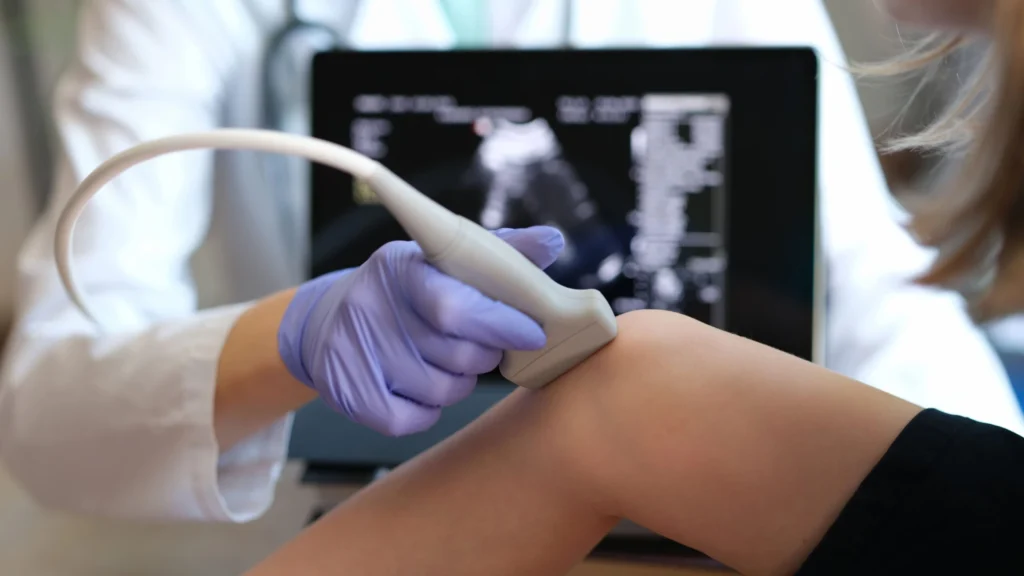
At Birmingham Physiocare Ltd on Pershore Road in Selly Oak, our specialist physiotherapist uses high-frequency diagnostic MSK ultrasound to visualise soft tissue structures with the same clinical rigour applied in hospital musculoskeletal imaging settings. Tendons, ligaments, bursae, joint spaces, nerves and fascia imaged dynamically during movement, not in static snapshots. The distinction between a tendinopathy and a structural tear confirmed at the appointment rather than assumed and treated around. A treatment plan built on imaging evidence from day one rather than a clinical estimate refined across multiple sessions.
MSK Ultrasound at Birmingham Physiocare is also the diagnostic foundation for our Ultrasound-Guided Injection service confirming the target structure before any needle advances and visualising placement in real time. For patients where chronic tendon pathology is identified, findings directly inform whether Shockwave Therapy is the appropriate next step.
Diagnostic imaging available at your first appointment across Birmingham, Selly Oak, Harborne, Edgbaston, Moseley, Sutton Coldfield and the wider West Midlands.
MSK ultrasound is not appropriate for every clinical presentation and your physiotherapist will advise honestly whether imaging will add diagnostic value to your assessment. For conditions involving tendons, bursae, ligaments and soft tissue structures where clinical examination alone cannot confirm the diagnosis, it provides a level of precision that changes the treatment decision. These are the presentations where it consistently delivers clinical value at Birmingham Physiocare.
What We Diagnose With MSK Ultrasound
- Rotator Cuff Tears and Tendinopathy: Partial and full-thickness tears of the supraspinatus, infraspinatus, subscapularis and teres minor tendons imaged in real time. Ultrasound differentiates between tendinopathy and a structural tear, a distinction that changes the treatment pathway completely and that clinical examination alone cannot reliably make.
- Subacromial and Trochanteric Bursitis: Bursal thickening and fluid accumulation confirmed at the exact location, directly guiding subsequent injection therapy to the precise bursal target rather than the estimated one.
- Plantar Fasciitis: Real-time imaging of the plantar fascia confirms fascial thickening and identifies the exact zone of pathology, establishing whether Shockwave Therapy, injection or rehabilitation represents the most clinically appropriate pathway.
- Achilles and Patellar Tendinopathy: Classification of tendon pathology by location, extent and degree of degeneration, directly informing loading parameters in rehabilitation and whether Shockwave Therapy is indicated for chronic degenerative presentations.
- Calcific Tendinopathy: Calcium deposits in the rotator cuff and other tendons clearly visible with size, location and developmental stage all informing whether Shockwave Therapy or image-guided needling and lavage is the recommended intervention.
- Ankle Ligament Assessment: Dynamic assessment of the anterior talofibular, calcaneofibular and deltoid ligaments for acute sprains and chronic instability, providing structural information that guides rehabilitation loading and return-to-activity decisions.
- Nerve Entrapment and Compression: Identification of carpal tunnel syndrome, cubital tunnel syndrome and Morton’s neuroma through direct nerve visualisation, providing diagnostic clarity before treatment or surgical referral decisions are made.
- Hip and Knee Joint Assessment: Joint effusions, osteoarthritic changes, labral pathology and soft tissue masses assessed in the clinic, informing whether injection therapy or rehabilitation is the priority intervention.
- Wrist and Hand Conditions: De Quervain’s tenosynovitis, ganglion cysts, trigger finger and TFCC pathology all imaged directly, with guided aspiration or injection available at the same appointment where clinically indicated.
Get in touch with us
service timing ( Mon to Fri )
09 Am To 6 Pm
service timing ( Sat to Sun )
10:30 Am To 5 Pm
Our Treatments
Birmingham Physiocare In a nutshell
What Makes Birmingham Physiocare Different?

Book Your Physiotherapy Assessment !
Imaging Inside The Consultation
Your scan happens at the same appointment as your clinical assessment conducted by the same physiotherapist treating you. You leave with a confirmed diagnosis, a written report and a treatment plan built on imaging evidence. Not a referral letter and a six week wait.
Diagnosis That Changes What Happens Next
MSK Ultrasound findings at Birmingham Physiocare directly determine whether manual therapy, Shockwave Therapy, injection therapy or exercise rehabilitation is the appropriate next step. Imaging is not an add-on here it is the clinical decision making tool that makes every subsequent treatment more precisely targeted.
Home Visits For Suitable Patients
Home Visits For Suitable PatientsFor patients unable to travel to our Pershore Road clinic, our domiciliary service is available for suitable presentations across Birmingham and the West Midlands. Contact us to confirm whether a home visit is clinically appropriate for your specific case.
HCPC & MCSP Registered
All MSK Ultrasound scanning and reporting at Birmingham Physiocare is conducted by our HCPC and MCSP registered chartered physiotherapist with specialist musculoskeletal imaging training. Every report is produced to clinical reporting standards and can be shared with your GP, consultant or specialist as required.
Our Treatement Approach
From First Appointment To Full Recovery
SCANNING PROCESS
BIRMINGHAM PHYSIOCARE
Step 1: Clinical Assessment
Step 2: Real-Time Imaging
Step 3: Diagnostics & Plan
Targeted Investigation
Step 1: Clinical Assessment Directs The Scan
Your physiotherapist conducts a thorough clinical assessment before the ultrasound probe is applied, taking a full history, assessing movement, strength, neurological status and joint mechanics relevant to your presentation.
The scan is then targeted precisely at the structures the clinical examination has identified as the likely source of your symptoms. Nothing is imaged on assumption; the assessment drives where the probe goes and what it looks for.
Dynamic Evaluation
Step 2: Real-Time Imaging, Explained As It Happens
A high-frequency ultrasound probe images the target structures in real time on a screen visible to both you and your physiotherapist. Dynamic assessment means structures are evaluated during movement, revealing pathology that static imaging misses.
Tendon integrity, bursal involvement, calcific deposits, joint fluid, nerve compression and soft tissue changes are identified and explained to you as the scan proceeds. You see what we see. You understand what it means before the probe is set down.
Clear Treatment Pathways
Step 3: Report, Diagnosis And Treatment Decision
A clinical report documenting scan findings is produced following your appointment. Your physiotherapist explains the diagnosis, answers your questions and outlines the recommended treatment pathway, whether that is physiotherapy, Shockwave Therapy, Ultrasound-Guided Injection or onward referral where indicated.
You leave knowing exactly what is causing your pain, why, and what the clinical plan looks like from this point forward.
TESTIMONIALS
What Our Patients Say About Their Journey

Told my shoulder pain was impingement and treated accordingly for months without improvement. Birmingham Physiocare scanned it at my first appointment and identified a partial rotator cuff tear that had been missed entirely. Treatment changed immediately and so did my recovery. The fact that they could do this at the first appointment, without any hospital referral, changed everything.
Eighteen months of plantar fasciitis that had not responded to anything I had tried. Birmingham Physiocare used ultrasound to properly assess what was happening in the fascia, confirmed significant thickening and recommended shockwave therapy based on what the scan showed. Four sessions later the pain that had been present every morning for a year and a half was gone. The ultrasound gave us an actual answer for the first time.
Hip pain for over a year and told it was arthritis throughout. The ultrasound at Birmingham Physiocare showed it was trochanteric bursitis a completely different condition requiring a completely different treatment. They injected the bursa under ultrasound guidance at the same session. The relief was almost immediate. I cannot understand why this level of assessment is not standard everywhere.
Frequently Asked Questions About Musculoskeletal Ultrasound at Birmingham
Essential FAQs
For soft tissue structures tendons, ligaments, bursae and muscles diagnostic MSK ultrasound performed by a trained specialist is comparable to MRI in diagnostic accuracy and in certain respects superior. Its key advantage is dynamic imaging structures can be assessed during movement, revealing pathology that static MRI cannot capture. A 2025 systematic review and meta-analysis published in Diagnostics confirmed ultrasound is highly accurate for anterior talofibular ligament assessment. MRI remains preferable for deep joint structures, bone marrow pathology and spinal assessment. Your physiotherapist will advise honestly whether ultrasound or MRI is more appropriate for your specific presentation.
MSK ultrasound is entirely non-invasive, painless and involves no radiation whatsoever it uses high-frequency sound waves, the same technology used in obstetric scanning. The probe is placed gently against the skin with coupling gel applied to optimise image quality. You may experience mild pressure when the probe passes over a tender area. There are no known adverse effects and no preparation is required beyond wearing or bringing loose clothing to allow access to the area being examined.
Yes. A formal clinical ultrasound report documenting all findings is produced following your scan. This report meets clinical reporting standards and can be shared with your GP, orthopaedic consultant, rheumatologist or any other healthcare provider involved in your care. For patients pursuing medico-legal claims, scan findings and reports can also be incorporated into physiotherapy medico-legal reports where relevant.
Yes and this is one of the most clinically significant capabilities at Birmingham Physiocare. Where diagnostic findings indicate that injection therapy is the appropriate intervention, our Ultrasound-Guided Injection service allows the diagnostic scan and the injection to be delivered at the same appointment by the same clinician. No separate booking. No second referral. Diagnosis confirmed and treatment delivered in a single session.
Wear loose, comfortable clothing that allows easy access to the area being assessed. For shoulder scans, a vest top or loose shirt is ideal. For knee and ankle scans, shorts or loose trousers. For hip assessments, loose trousers or shorts. You do not need to remove jewellery unless it is directly over the area being scanned. No other preparation is required you can eat, drink and take your regular medication as normal before your appointment.
SAME-DAY DIAGNOSTIC IMAGING
Need A Musculoskeletal Ultrasound In Birmingham?
Same-day scanning and diagnosis at 650 Pershore Road, B29 7NX — no referral required. Speak to our specialist team today.